Please record which of them you are prepared to present.
Topics: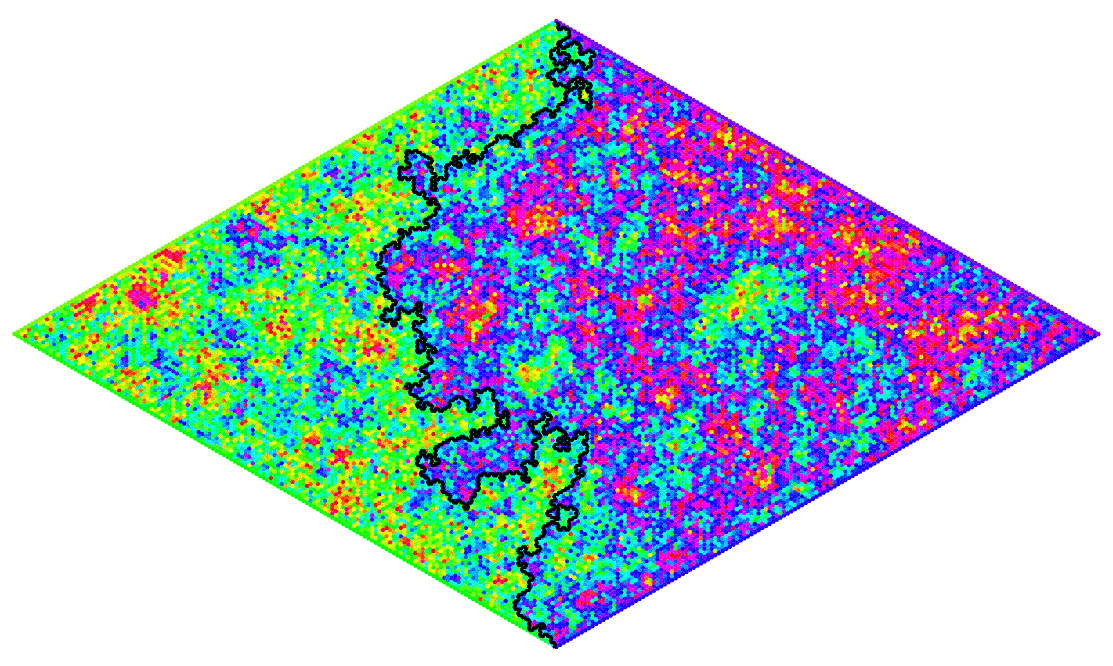
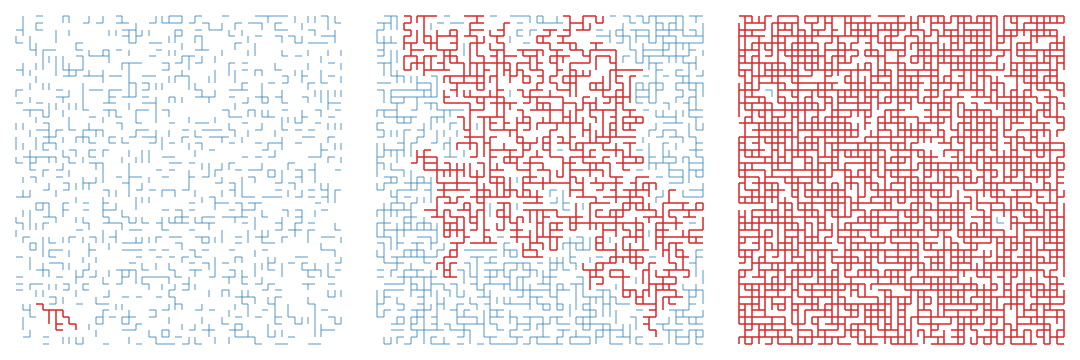
Percolation theory: definitions and their equivalence. Examples using the Peierls contour method, first and second moment method. The Harris-FKG correlation inequality.
The Ising model on finite graphs: definition, spatial Markov property, basic properties of the partition function, definition of long range order.
Glauber dynamics and other Markov chains. Holley's proof of the FKG-inequality. Infinite volume Gibbs measures.
The FK random cluster model, Edwards-Sokal coupling, the Potts models, Uniform Spanning Tree.
Mean field models: Erdős-Rényi random graph and the Curie-Weiss phase transition.
Pólya’s theorem on recurrence versus transience of simple random walk on Z^d. Green's function.
The Discrete Gaussian Free Field (DGFF) on graphs. Relation to other models, such as Ising.
Intuitive glances at more advanced topics:
Critical point for planar percolation: the Harris-Kesten theorem (1980).
Scaling limits: Brownian motion. Continuum GFF. The conformal invariance of critical planar percolation and other FK models. (Fields medals to W. Werner 2006 and S. Smirnov 2010.)
Mermin-Wagner and Kosterlitz-Thouless on the XY model in the plane: what is a topological phase transition? (Nobel prize in physics 2016)
What is a spin glass? (Nobel prize in physics to Parisi 2021)
Self-organized criticality, such as sandpiles (Bak-Tang-Wiesenfeld 1987, Nobel prize in physics 2033).
Diary
Feb 20: We introduced bond and site percolation, defined transitivity of a graph, defined p_c in two different ways, dwelled a little bit on measurability issues (including the statement of the Banach-Tarski paradox), proved p_c(\Z)=1 for the integer line, guessed p_c(\T_d)=1/(d-1) for the d-regular tree, and stated (but have not proved) that \theta(p) is increasing, right-continuous, and left-continuous except possibly at p_c. We will prove most of these and 1/3 \leq p_c(\Z^2) \leq 2/3 next time.
You can watch this award-winning video or start reading Section 12.1 of my PGG lecture notes.
If you are curious about the Banach-Tarski paradox, I have not watched this, but it should be good.
Feb 27: We introduced the notion and proved that P_q stochastically dominates P_p for q>p, and concluded that \theta(p) is monotone increasing. Proved that p_c(\Z)=1. Proved using the probability generating function f(s):=E[s^\xi] of the offspring distribution \xi that a Galton-Watson branching process tree is infinite with positive probability if and only of either P[\xi=1]=1, or \E\xi>1.
See the relevant parts of PGG Section 12.1, or the Lyons-Peres book Section 5.1.
March 6: Discussing a second method to prove the phase transition for GW trees at \E\xi=1; see Exercise 1/5. Kolmogorov's 0/1 law. Proved 1/3 \leq p_c(\Z^2,bond) \leq 2/3.
March 13: Discussed Exercises 1/8 and 9. Percolation on \Z^2 at p=1/2: self-duality. Stated the Harris-FKG inequality and the Russo-Seymour-Welsh box-crossing estimates.
March 20: Discussed Exercises 1/1, 2, and 5. The difference between the Weak and Strong Laws of Large Numbers, and between convergence in probability and almost surely, in general. The Borel-Cantelli lemmas.
March 27: Intro to Markov chains. Stationary and reversible measures. Recurrence vs transience: a sketch of Pólya's theorem.
April 16: Gregorio on a percolation model for turbulence spreading. A very brief intro to universality and conformal invariance of Brownian motion and planar percolation.
April 23: The Ising model of magnetization.
Bibliography
Rick Durrett. Probability: theory and examples. 5th edition. Cambridge University Press, 2019. https://services.math.duke.edu/~rtd/PTE/PTE5_011119.pdf.
Rick Durrett. Random graph dynamics. Cambridge University Press, 2007. https://www.math.duke.edu/~rtd/RGD/RGD.pdf.
Geoffrey Grimmett. Probability on graphs. Cambridge University Press, 2010. http://www.statslab.cam.ac.uk/~grg/books/pgs.html.
Remco van der Hofstad. Random graphs and complex networks, Vol. I. Cambridge University Press, 2017. http://www.win.tue.nl/~rhofstad/NotesRGCN.pdf
Olle Haggstrom: Markov chains and mixing times. American Mathematical Society, 2008. http://pages.uoregon.edu/dlevin/MARKOV/.
David Levin, Yuval Peres, Elizabeth Wilmer. Markov chains and mixing times. American Mathematical Society, 2008. http://pages.uoregon.edu/dlevin/MARKOV/.
Russ Lyons and Yuval Peres. Probability on trees and networks. Cambridge University Press, 2016. http://mypage.iu.edu/%7Erdlyons/prbtree/prbtree.html
Gábor Pete. Probability and geometry on groups. Book in preparation. PGG.pdf