


For the English version of the introduction click here
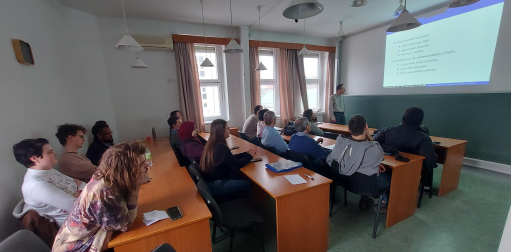 A BME Matematika Intézet Analízis és Differenciálegyenletek Tanszékének közös Alkalmazott Analízis Szemináriuma 2016. őszén indult Faragó István (Differenciálegyenletek Tanszék) kezdeményezésére az MTA-ELTE Numerikus Analízis és Nagy Hálózatok Kutatócsoporttal együttműködésben. A szeminárium célja, hogy elősegítse egy alkalmazott analízissel (funkcionálanalízis, differenciálegyenletek, numerikus módszerek) foglalkozó kutatói kör kialakítását az intézeten belül. A szemináriummal fórumot szeretnénk biztosítani az alkalmazott analízissel foglalkozó matematikusok és az analízist alkalmazó kutatók számára az együtt gondolkodásra. További cél az érdeklődő hallgatók (MSc, PhD) bevonása a kutatói munkába.
Szemináriumunk 2017-től felvette a Farkas Miklós Alkalmazott Analízis Szeminárium nevet. Ezzel szeretnénk emléket állítani egyetemünk egykori tanszékvezető matematikaprofesszorának, aki elindította egyetemünkön a matematikus-mérnök képzést, és a stabilitáselmélet valamint a biomatematika terén elért jelentős tudományos eredményeivel ill. könyveivel nagyban hozzájárult az alkalmazott matematika erősödéséhez.
A covid járvány miatt három évig szünetelt a szeminárium. 2023. szeptemberétől indult újra a korábban említett szervezetek utódjainak (BME Analízis és Operációkutatás Tanszék, HUN-REN-ELTE Numerikus Analízis és Nagy Hálózatok Kutatócsoport) szervezésében.
The talks are in English on a regular basis. / Az előadásokat angol nyelven tartjuk.
Organizers / Szervezők:  Faragó István1,2,3,
  Karátson János1,2,3 ,
 Horváth Róbert1,3 ,
 Mincsovics Miklós1,3 ,
  Svantnerné Sebestyén Gabriella1,3 (1BME, 2ELTE, 3HUN-REN-ELTE NUMNET)
Next seminar: 8 October, 10:15, BME H207 (directions)
 Petra Csomós (ELTE Eötvös Loránd University, Department of Applied Analysis and Computational Mathematics)
A numerical method for delay differential equations with application to epidemic models
In this talk, we introduce a numerical method for solving delay differential equations based on operator splitting techniques and Magnus integrators. The rigorous error analysis relies on tools from functional analysis, in particular operator semigroups and evolution families.
We consider a broad class of semilinear and quasilinear delay differential equations and develop a fully discrete time-and-space numerical method in an abstract framework. An operator splitting technique is used to decompose the problem into simpler subproblems. The solution of one subproblem is represented by an operator semigroup, while the solution of the nonautonomous second subproblem is described by an evolution family and approximated using Magnus integrators. The resulting semigroup operators are then approximated by finite-dimensional operators through spatial discretization, such as finite differences or finite element methods, as well as Fourier or Galerkin methods.
We present the main ideas of the error analysis and show that the time and space discretization errors can be treated separately. In particular, the proposed method achieves second-order convergence in time due to the combination of Strang splitting and the Magnus approximation, while the spatial discretization contributes an independent error term. This separation makes it straightforward to balance the spatial discretization and timestep in order to achieve an optimal overall convergence rate.
Finally, we illustrate the theoretical results using an epidemic model with a latent period, vaccination, and random movement of individuals, and present corresponding numerical simulations. The example demonstrates how operator semigroups can provide a systematic framework for the design and analysis of numerical methods for nonlinear delay differential equations, with applications to epidemic modelling.
Previous seminars
Presentations in 2025/26, 2024/25, 2023/24, 2019/20, 2018/19, 2017/18, 2016/17